
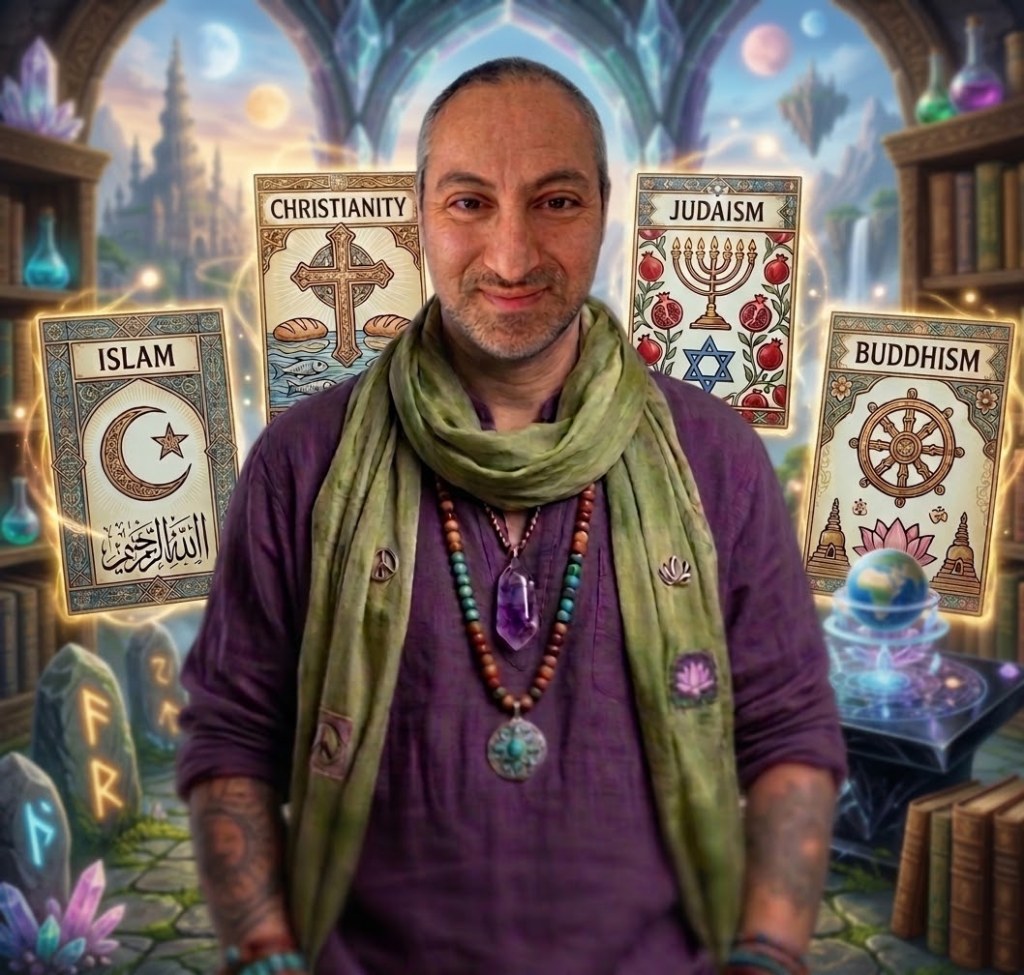
Zonkatron believes that happiness is the ultimate purpose for everyone, and for happiness to be attained, every person needs to nurture certain soul qualities.
🍀 In the history of humanity, there were many civilizations that were lacking in some specific soul qualities. This gave rise to wise men who made it their mission in life to teach those qualities.
Zonkatron explained that this is exactly what gave rise to the biggest four religions that most people even to this day keep following.
The four big soul qualities according to Zonkatron are: Justice, Love, Modesty, and Detachment

🕎 1. Moses: From Observing Injustice to Championing Righteousness
Before he was a prophet, Moses was an observer. Raised in the halls of Egyptian royalty, he couldn’t turn a blind eye to the brutal systemic oppression of the Hebrew people. The pivotal moment of his early life occurred when he witnessed an Egyptian taskmaster beating a Hebrew slave—an act of blatant cruelty that ignited his lifelong commitment to righteousness.
🏵️Moses’s core message was rooted in justice and law. He didn’t just teach personal morality; he delivered a framework for an ethical society. Through the Commandments and legal codes, his legacy established that no individual—king or commoner—is above the law, and that a society’s moral strength is measured by how it treats the vulnerable.
The associated negative emotion to injustice is: Sadness
✝️ 2. Jesus: Healing a Cold World with Unconditional Love
Jesus lived in a world dominated by rigid religious legalism, political division, and social ostracization. He observed a society where rules were often used as weapons to exclude, condemn, and divide people, leaving a profound deficit of warmth, empathy, and genuine connection.
🏵️In response, Jesus placed unconditional love (agape) at the center of his teachings. He crossed social boundaries to dine with outcasts, healed the sick, and challenged people to love not just their neighbors, but their enemies. His message shifted the focus from merely following external rules to cultivating radical compassion in the heart.
The associated negative emotion to love is: Hate
☪️ 3. Prophet Muhammad: Countering Arrogance with Radical Humility
In 7th-century Arabia, societal structure was deeply tied to tribal pride, wealth, lineage, and personal status. Ego and arrogance often dictated social standing, leading to the mistreatment of the weak and a culture dominated by pride.
🏵️Prophet Muhammad addressed this by teaching humility before the Divine and equality among people. He emphasized that all human beings are equal, like the teeth of a comb, with no superiority based on race or lineage. He modeled a life of deep personal humility, encouraging his followers to view themselves as humble servants (‘abd) to God, shedding pride, self-importance, and social hierarchy.
The associated negative emotion to modesty is: Arrogance
☸️ 4. The Buddha: Freedom from Attachment Through Mindful Presence
Siddhartha Gautama grew up surrounded by luxury, shielded from the realities of sickness, aging, and death. Upon stepping outside his palace walls, he recognized a fundamental truth: human suffering stems from our intense attachment to transient things—wealth, sensory pleasures, and status.
🏵️The Buddha’s message centered on detachment and mindfulness. He taught that clinging to temporary pleasures creates an endless cycle of desire and disappointment. Through the practice of meditation and present-moment awareness, he demonstrated how to observe reality without clinging to it, uncovering a state of lasting peace (Nirvana).
The associated negative emotion to Detachment is: Anxiety
🏵️Even though these four guys lived a really long time ago, their ideas are still super useful today. If we all try to be fair like Moses, loving like Jesus, humble like Muhammad, and peaceful like Buddha, the world would be an awesome playground for everybody!



Leave a Reply