
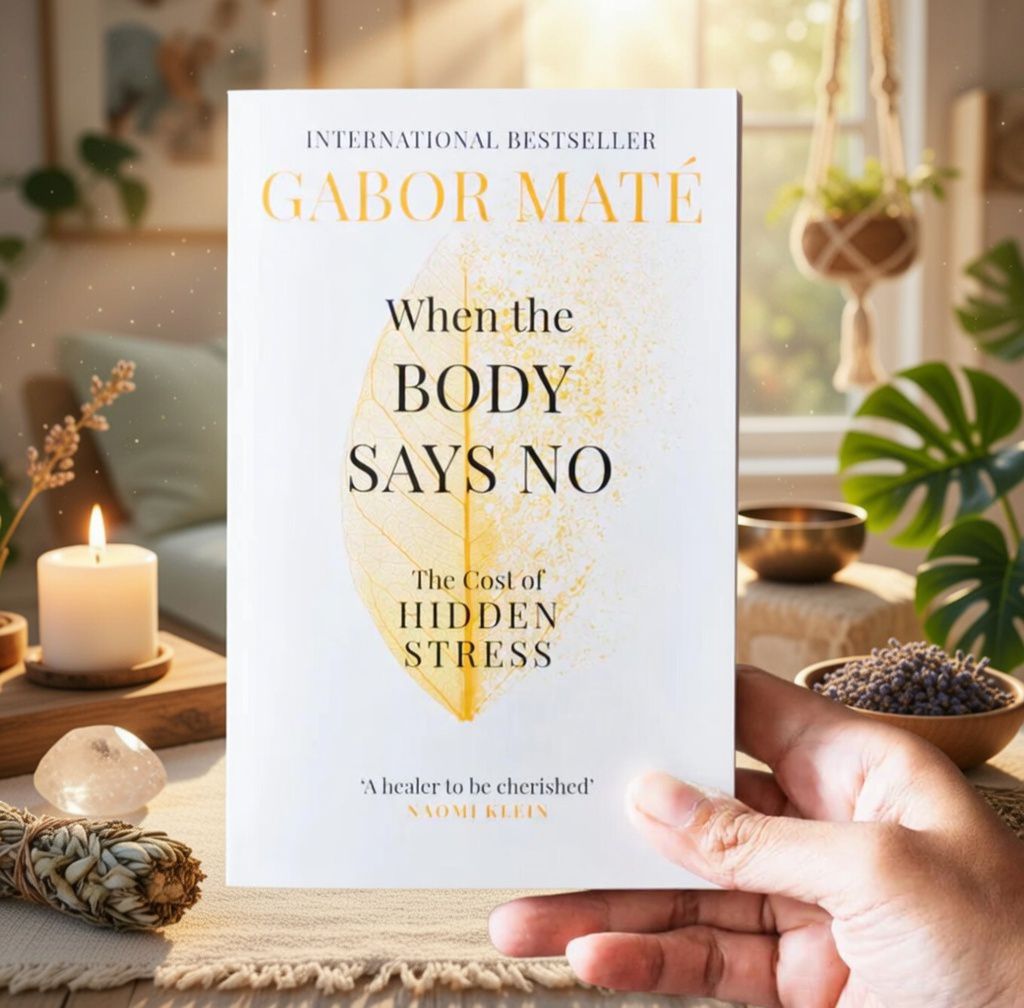
Hey there! I’m happy to dive into the heavy, heart-wrenching, but ultimately healing world of Gabor Maté’s When the Body Says No.
Maté argues that our minds and bodies aren’t separate entities—they are one single system, and when we don’t listen to our emotional needs, our biology eventually forces us to.
1. The Myth of the “Nice” Person
Maté starts with a bit of a gut punch: being “too nice” might actually be killing us. He isn’t talking about genuine kindness, but rather a compulsive need to please others while suppressing our own anger or needs. He looks at people with chronic illnesses like ALS or MS and notices a pattern—many were “saints” who never said no. Historically, we’ve praised this self-sacrifice, but our immune systems see it differently. When we swallow our anger to keep the peace, our body treats that suppressed emotion like a physiological stressor, weakening our defenses from the inside out.
2. The Stress Connection (Psychoneuroimmunology)
This is the “sciencey” part, but think of it as a web. Maté explains Psychoneuroimmunology (PNI), which is basically the study of how our thoughts and emotions (psycho) affect our brain (neuro) and our immune system (immuno).
He shares the story of Mary, a woman with scleroderma, who spent her whole life taking care of an abusive family. Her brain was constantly in “fight or flight” mode, pumping out cortisol. Over decades, that high-octane stress response didn’t just stay in her head; it told her immune system to start attacking her own tissues. It’s a vivid example of how the body eventually screams what the mouth refuses to say.
3. The “C” Word: Cancer and Repression
Maté doesn’t say stress causes cancer, but he argues it creates the “soil” in which cancer can grow. He cites studies showing that women who suppress their emotions—especially anger—have higher risks of breast cancer. He tells the story of a man who was the “rock” of his community, always steady, never complaining, who died of a rapid malignancy. By never expressing his own pain, his body’s natural killer cells (the ones that fight tumors) basically fell asleep on the job because they were suppressed by chronic stress hormones.
4. The Roots in Childhood
Why do we do this? Maté goes back to our earliest years. If a child learns that expressing anger or sadness makes their parent withdraw or get angry, that child learns that “being myself is dangerous.” To survive, they adapt by becoming “the good kid.” This isn’t a conscious choice; it’s a biological survival strategy. Decades later, that child is now an adult who can’t say “no” to a boss or a spouse, because their nervous system still thinks “no” equals “abandonment.”
5. The Seven A’s of Healing
Maté doesn’t just leave us in the gloom; he offers a path out through the “Seven A’s”:
- Acceptance: Acknowledging things as they are, without rose-colored glasses.
- Awareness: Learning to feel the physical signs of stress before they become a disease.
- Anger: Not “rage,” but healthy boundary-setting.
- Autonomy: Taking control of your own life and choices.
- Attachment: Connecting with others in a way that allows you to be your true self.
- Assertion: Declaring to the world, “This is who I am.”
- Affirmation: Moving toward your own creative and spiritual purpose.
It’s a lot to process, right? It really makes you rethink every time you’ve said “yes” when every fiber of your being wanted to say “no.”

 Zonkatron
Leave a comment