
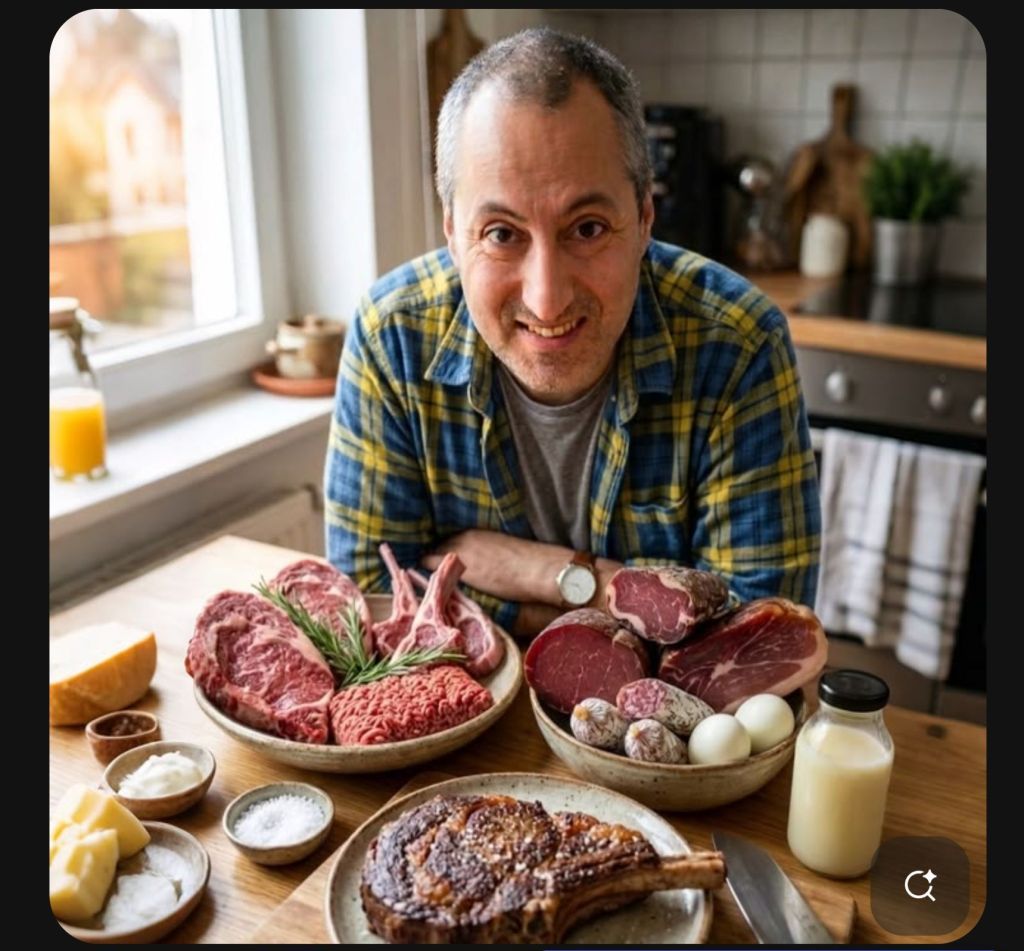
Okay so look—I didn’t wake up one morning thinking I’d eat nothing but meat for months. Nobody does. That’s the thing about these experiments, they start small. A week.
Maybe two. “Let’s see what happens,” you tell yourself, standing in front of the mirror, poking your bloated gut after another night of beer and bread. And then suddenly it’s six months later and you’re arguing with strangers on Reddit about whether organ meats count as “nose-to-tail” if you buy them frozen.
My own carnivore journey—god, I hate calling it a “journey,” but what else do you call it?—began in 2019. I’d been keto for two years, lost 40 pounds, felt decent. But the vegetables. The endless vegetables. Spinach, kale, broccoli, cauliflower rice that tastes like sadness. I was eating them because I was supposed to. Fiber, micronutrients, antioxidants, all that. But my gut was still a mess. Alternating between—well, you know. The bathroom situation was unpredictable. And I started noticing something: on days when I just said screw it and ate a steak for dinner, skipping the side salad, I felt… better? Lighter? Less like my intestines were hosting a civil war?
So I did what any reasonable person does. I went down the rabbit hole.
The historical precedent for this is wild, by the way. Everyone thinks carnivore is some new internet fad, some Joe Rogan podcast nonsense. But humans have been doing meat-only or meat-heavy experiments for centuries. The Inuit, obviously—though calling their traditional diet an “experiment” is colonial and dumb, it was survival. But the documented experiments? Those are fascinating. Vilhjalmur Stefansson, the Arctic explorer, lived with the Inuit from 1906 to 1918, ate almost exclusively caribou, fish, seal, and whale. When he came back and told the medical establishment he’d been healthy as hell with basically zero plant foods, they called him a liar. A fraud. “You’ll die of scurvy,” they said. “Your bones will dissolve.” So in 1928, Stefansson and his colleague Karsten Anderson checked into Bellevue Hospital in New York and let doctors watch them eat nothing but meat for a full year. A year! Blood tests, urine tests, stool tests—the whole humiliating nine yards. And they were fine. Better than fine. No scurvy. No deficiencies. Stefansson later wrote that he’d “never felt better in his life.” The medical journals published the results and then… everyone forgot about it. Buried it. Because it didn’t fit the narrative. The narrative being, of course, that plants are sacred and meat will kill you.
I thought about Stefansson a lot during my first month. Because that first month is brutal. Not physically—surprisingly, my energy was stable, my gym performance didn’t drop. But psychologically? Eating nothing but meat is boring. You don’t realize how much variety matters until it’s gone. Breakfast: eggs and bacon. Lunch: ground beef. Dinner: steak. Snack: more beef, maybe some cheese if you’re doing “animal products” rather than strict carnivore. Day after day. Week after week. I started dreaming about apples. Actual dreams—vivid, Technicolor dreams about biting into a crisp Honeycrisp. I told this to a friend and he said, “That’s your body telling you it needs carbs.” But was it? Or was it just habit, addiction to sweetness, the same way smokers dream about cigarettes when they quit?
The “meat withdrawal” phenomenon is real, though. The first two weeks, I was exhausted. Not hungry, exactly—meat is incredibly satiating, that’s one thing everyone agrees on—but empty. Like my cells were confused. Where’s the glucose? Where’s the quick hit? I learned later that this is metabolic adaptation. Your body has to upregulate enzymes for ketone utilization, for gluconeogenesis. It takes time. Some people call it the “keto flu,” but on carnivore it’s more intense because there’s zero carb cushion. No 20 grams of berries to take the edge off. Just you and your liver, making glucose from protein like we’re all supposed to know how to do but forgot because we’ve been eating cereal since childhood.
And then—week three, maybe four—something shifts. The fog lifts. Not gradually. Suddenly. I remember waking up at 6 AM without an alarm, completely alert, and thinking, “What the hell is this?” I’d been a lifelong snooze-button abuser. Now I was that annoying person who jumps out of bed ready to go. My gym sessions got weird too. I was lifting heavier, sure, but more than that—I wasn’t getting sore. Or rather, I’d get sore for a few hours and then it would vanish. Inflammation, I realized. I’d been inflamed my whole adult life and just accepted it as normal. The achy joints, the puffy face in the morning, the general sense that my body was working too hard to do basic things. Gone.
But here’s where it gets messy, where the carnivore community doesn’t like to talk. Because it’s not all miracle cures and six-pack abs. I developed—how do I put this delicately—digestive issues. The opposite of what I’d expected. Constipation, despite eating zero fiber. Which contradicts everything we’re taught, right? Fiber keeps you regular! But no, apparently, you don’t need fiber to poop. You need enough fat, enough bile, enough time for your gut bacteria to adjust to their new food source. I was eating too lean. Too much chicken breast, not enough ribeye. When I switched to fattier cuts, added more butter, things normalized. But it took experimentation. Trial and error. And during that trial period, I was miserable. Bloated, uncomfortable, questioning everything.
The mental health claims are where I get really conflicted. Because I felt better. More stable. Less anxious. But was that the diet, or was that the placebo effect of doing something extreme and feeling like I had control? Hard to say. There are anecdotes everywhere—Jordan Peterson and his daughter Mikhaila, most famously, both claiming carnivore eliminated their depression, their autoimmune issues. Mikhaila’s story is particularly wild: juvenile arthritis, severe depression, skin problems, all supposedly resolved by eating only beef, salt, and water. She calls it the “Lion Diet.” Critics call it dangerous and unscientific. But the Petersons aren’t stupid people. Jordan is a clinical psychologist, whatever you think of his politics. He wouldn’t stick with something that wasn’t helping. Would he?
I think about the placebo effect a lot with diets. It’s powerful. Maybe the most powerful drug we have. But here’s the thing: if you feel better, does it matter why? If your depression lifts because you believe meat is healing you, is that less valid than if it lifts because of some biochemical mechanism we haven’t identified yet? I don’t know. I genuinely don’t know. What I know is that during my three-month strict carnivore period, my lifelong low-grade anxiety—the constant background hum of worry—dimmed significantly. Maybe it was the elimination of plant toxins, lectins, whatever. Maybe it was ketones feeding my brain more efficiently. Maybe it was the simplicity of the diet reducing decision fatigue. Or maybe I just finally felt like I was doing something right for once, and that confidence spilled over.
The social aspect is brutal, though. Nobody warns you about this. Eating becomes an isolating experience. Restaurants are minefields. “I’ll have the steak, no sides, no sauce, no seasoning except salt.” The waiter’s face. Your friends’ faces. The explanations you have to give, over and over, while everyone else is sharing appetizers and drinking wine and bonding over the shared experience of food. Food is social glue. It’s how we connect, celebrate, comfort. And carnivore strips that away. You become the weird one. The difficult one. The person who can’t just enjoy a normal meal. I lost friends over this, or at least drifted from them. Not because they were jerks, but because I made every dinner party awkward. “No, I can’t have the salad. No, not even a little. Yes, I’m serious. Yes, I know about scurvy. Yes, I’ve heard of fiber. Can we talk about something else?”
And the cost! Oh god, the cost. Quality meat is expensive. If you’re doing carnivore right—grass-fed, pasture-raised, organic, all the buzzwords—your grocery bill doubles or triples. I was spending 400 a month on food, just for me. Ground beef became my staple because I couldn’t afford ribeyes every day. Organ meats too, which are cheap and nutrient-dense but require you to actually cook and eat liver, which tastes like licking a penny that’s been sitting in a swamp. I tried every preparation. Soaked in milk. Fried with onions (wait, no onions, just salt). Blended into “liver smoothies” with raw egg. Nothing made it pleasant. Just tolerable. And I ate it because the carnivore gurus all say you need organ meats for the micronutrients, for the “nose-to-tail” philosophy. But do you? Really? Stefansson didn’t eat organs regularly. The Maasai don’t. They eat muscle meat and blood and milk and they’re fine. So maybe the liver thing is just another layer of orthorexia, of diet perfectionism.
I experimented with variations. Strict beef-only for a month. Felt good, but missed variety. Added back eggs—no issues. Added back dairy—some acne, so cut it out again. Tried “carnivore-adjacent” with coffee (technically not an animal product, but come on, I’m not a saint). Fish, shellfish, pork, lamb. Each introduction taught me something. Pork gave me headaches, I realized. Something in it doesn’t agree with me. I’d never have known eating a standard diet. Fish made me feel light, clear-headed. Lamb was perfect but too expensive. Beef was the baseline, the reliable friend.
The long-term concerns are real and I can’t ignore them. No long-term studies on carnivore. None. We have n=1 experiments, we have historical populations, we have short-term metabolic ward studies. But nobody’s tracked a thousand people eating only meat for twenty years and compared them to controls. So we’re guessing. Educated guessing, maybe, based on evolutionary biology and biochemistry, but still guessing. Colon cancer risk? The data on red meat and cancer is observational, confounded by lifestyle factors, but it’s not nothing. Gut microbiome diversity? Carnivore guts are less diverse, full of bile-tolerant microbes, missing the fiber-fermenters. Is that bad? We don’t know. Maybe diversity isn’t the only metric that matters. Maybe having the right microbes for your diet matters more than having many kinds.
I think about the explorers a lot. Not just Stefansson, but the ones before him. The Franklin expedition, 1845, trying to find the Northwest Passage. They had canned food, preserved with lead, and they died—scurvy, starvation, madness. But the Inuit they encountered, eating their traditional diet, were fine. Thriving. The British didn’t learn. They kept bringing biscuits and lime juice (which degrades quickly and doesn’t prevent scurvy as well as fresh meat) and dying. It took decades for the Royal Navy to accept that fresh meat prevented scurvy better than citrus. Decades of preventable death because the paradigm was too strong. Plants cure disease. Meat causes it. Even when the evidence screamed otherwise.
Am I saying carnivore is the answer? I don’t know. I really don’t. I stopped after four months. Added back fruit first—berries, the safe choice. Felt fine. Added back vegetables—some bloating, some skin issues, so I kept them minimal. Now I eat mostly meat, some fruit, some fermented foods. Not carnivore anymore. But carnivore-informed, I guess. It taught me what my body actually needs versus what I was told it needs. It broke my addiction to sugar, to processed foods, to the idea that every meal needs to be exciting. Food is fuel. That sounds depressing, but it’s actually liberating. When you stop expecting food to entertain you, to comfort you, to solve your boredom, you find other ways to meet those needs. Better ways, mostly.
The carnivore community online is… a lot. Very tribal. Very defensive. Which I understand, because mainstream nutrition has been hostile to them, dismissive, calling them dangerous cultists. But the defensiveness leads to its own problems. Questioning any aspect of the diet gets you labeled a “plant shill” or “not doing it right.” The success stories are amplified, the failures buried. People who feel terrible on carnivore leave the groups, stop posting, so the echo chamber reinforces itself. I saw this happen. Someone would post, “Month three, feeling awful, no energy, losing hair,” and the responses would be “Eat more fat!” “You’re detoxing!” “Add organs!” Rarely: “Maybe this isn’t for you.” Rarely: “Maybe stop.”
And that’s the real lesson, I think. These experiments matter. Self-experimentation is how we learn, individually and collectively. But we have to be honest about the results, even when they don’t fit the narrative. Carnivore helped me. It might help you. It might hurt you. The only way to know is to try, carefully, with medical supervision, with willingness to stop if things go wrong. Not as a religion. As a tool. One tool among many.
I still eat steak for breakfast sometimes. Just because I can.

 Zonkatron
Leave a reply to starstrucksweetse1807e6585 Cancel reply