
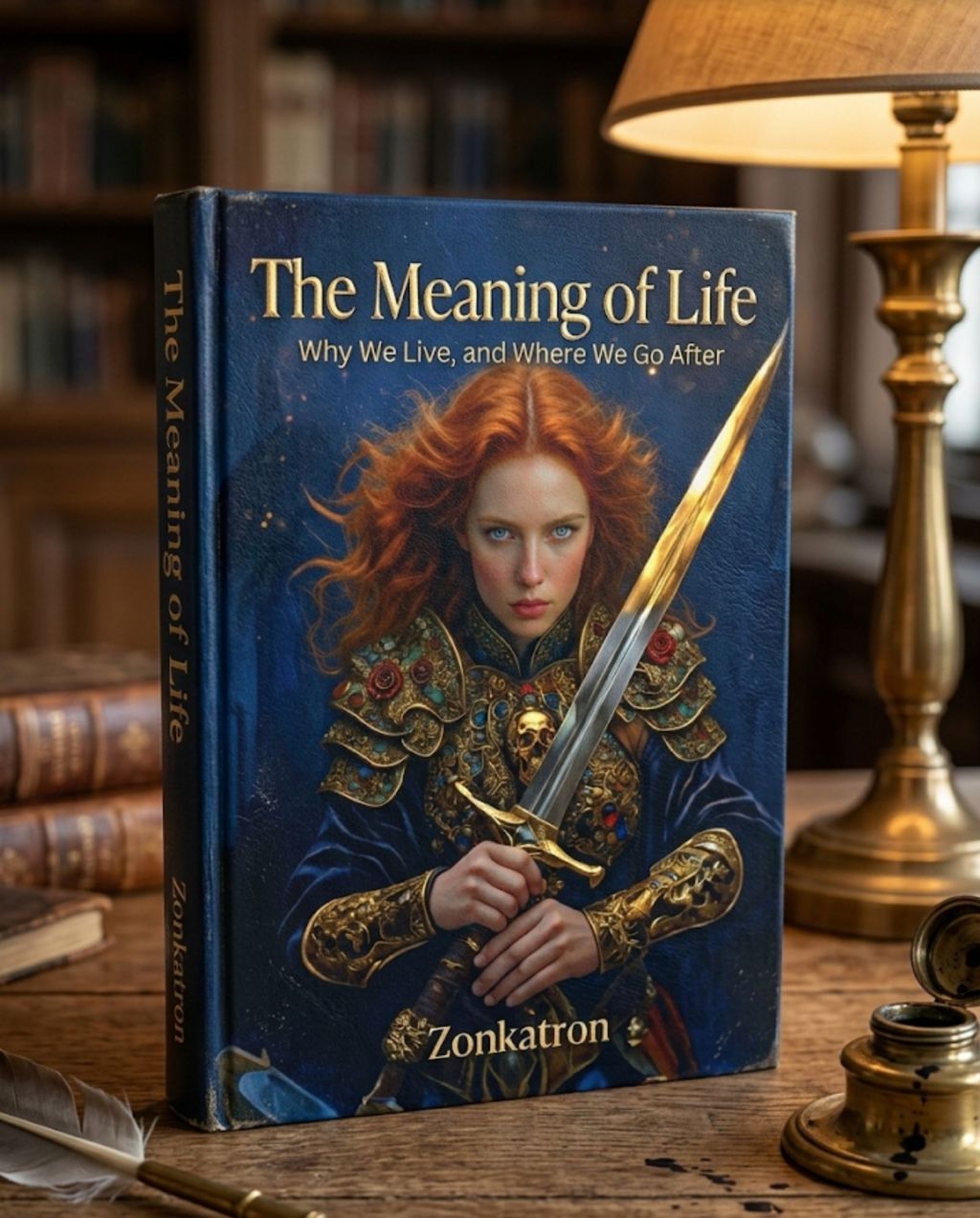
This is an extract of my book: The Meaning of Life, by Zonkatron
The Importance of Purpose
Living without a purpose is like being stuck in a giant, confusing escape room where nobody ever tells you the rules and there’s no way out. If you don’t have a “why” for being here, then every time life kicks you—which it will—it just feels like a cruel, random joke. It’s the difference between a gym rat who loves the burn in their muscles because they’re getting ripped, and a guy who’s just being forced to carry heavy boxes for no reason. Both are hurting, but only one of them is actually doing something with that pain.
Think about the guys who survived the absolute worst of history, like the psychologist Viktor Frankl in the Nazi concentration camps. He noticed something wild: it wasn’t the biggest, toughest guy who made it through. It was the people who had a reason to keep breathing. Some wanted to finish a book, some wanted to see their kids again. The ones who lost their purpose? They just withered away. Without a “why,” the suffering was just noise, and it eventually broke them.
Now, philosophers have spent thousands of years trying to “fix” this problem with their brains. They sit in dusty libraries writing 800-page books with words like “transcendental idealism.” Honestly? Most of it is boring as hell and doesn’t help you when you’re crying in your car at 2:00 AM. They treat life like a math problem to be solved, but you can’t think your way into a meaningful life.
These abstract theories feel empty because they’re just maps. Imagine someone showing you a map of Hawaii. They can point to the beaches and the volcanoes, but that’s not the same thing as feeling the sand between your toes or smelling the salt air. Logic is great for building a bridge, but it hurts to explain why the bridge is worth crossing in the first place.
This is where the “divine” or the big spiritual stuff comes in. And I’m not talking about boring Sunday school lessons. I’m talking about a direct, “holy crap” kind of experience. Take Saul from the Bible. The guy was a total skeptic until he got knocked off his horse by a literal blinding light. He didn’t need a PowerPoint presentation after that. One direct experience shattered his old logic and gave him a purpose that lasted until the day he died.
The cool thing about experience is that it’s like a sledgehammer for your brain. We all live in these little mental boxes, thinking we know how the world works. But then something happens—maybe you see a sunset that’s so beautiful it makes you want to cry, or you hold a newborn baby—and suddenly, the “logic” that life is just a random accident doesn’t fit anymore. Once you’ve tasted the real thing, no philosopher can talk you out of it.
Look at Florence Nightingale. Back in the day, rich ladies didn’t go scrub floors in bloody war hospitals. It was a terrible career move! But she said she heard a direct “call” from God. She didn’t sit around weighing the pros and cons in a journal; she just knew. That sense of purpose made her able to stand the smell and the death of the Crimean War. It wasn’t a theory to her; it was a mission.
When you’re just drifting through life randomly, you’re basically a leaf in the wind. If something good happens, you’re happy. If something bad happens, you’re miserable. But when you have a purpose, you have a rudder. Take those old-school explorers who sailed across the ocean in tiny wooden boats. They dealt with scurvy, storms, and the very real chance of falling off the edge of the world. Why? Because they were obsessed with seeing what was over the horizon. That “why” made the “how” bearable.
Think about a mom or dad with a screaming toddler at 3:00 AM. If you look at that situation logically, it’s a nightmare. You’re losing sleep, you’re stressed, and your ears are ringing. But parents don’t do it because it’s a “logical” use of their time. They do it because of a deep, soul-level purpose called love. Exhaustion isn’t just a random ordeal; it’s an act of service.
The purpose transforms the pain.
We see the “random ordeal” of life everywhere today in people who are “successful” but miserable. They’ve got the house, the car, and the fancy title, but they feel like they’re running on a treadmill that’s going nowhere. They have a “what” but no “why.” But the second that same person starts volunteering or finds a cause they actually care about, it’s like someone flipped a light switch. The work is still hard, but now it means something.
History is packed with “mystics”—people who didn’t care about the big fancy universities. There was this woman, Julian of Norwich, who lived in a tiny room attached to a church. She didn’t have a PhD, but she had these intense visions of God’s love. She came out of it saying, “All shall be well,” even in a world full of plague and war. She didn’t need a library to tell her the meaning of life; she had felt it, and that was enough.
There’s a kind of ego in thinking we can “figure out” life with just our thoughts. It’s like trying to explain what the color red looks like to someone who can’t see. You can talk about light waves and physics all day, but they still won’t “get” it until they see it. To find the meaning of life, you have to stop being a spectator and actually get in the game.
Have you heard the story about the two guys cutting stone? One guy is grumpy, sweating, and hates his life. He says, “I’m just cutting these stupid rocks.” The guy next to him is doing the exact same thing but he’s whistling. He says, “I’m building a cathedral.”
The first guy is working a job; the second guy is fulfilling a purpose. Same rocks, totally different lives. Purpose is the magic sauce that turns a chore into a masterpiece.
When you have a big, direct experience, there’s no going back. Think about astronauts who go to space and see Earth as this tiny, beautiful blue ball. It’s called the “Overview Effect.” They don’t come back and argue about border disputes or politics the same way. They’ve seen the truth. Their old “logic” about why we should fight each other just falls apart because they experienced a bigger reality.
Living without purpose is like driving a car in a thick fog. You’re terrified of hitting something, and every bump in the road feels like a disaster. But once the fog clears and you see your destination, the bumps don’t matter as much. You just keep driving. The suffering doesn’t stop, but it becomes the fuel that gets you where you’re going.
A lot of people are scared of “spiritual” talk because it sounds “woo-woo” or unscientific. But honestly, the most scientific thing you can do is check your own data. When have you felt the most “on fire”? When did you feel like you were exactly where you were supposed to be? It probably wasn’t when you were debating philosophy. It was when you were helping someone or creating something. Trust that data.
Psychologists have found that “meaning-making” is the best way to heal. Look at people who start charities after losing a loved one. They take a random, horrible ordeal and turn it into a purpose. The tragedy still hurts, but by giving it a purpose, they take the power back. They aren’t just victims of a random universe anymore; they’re architects of something good.
The best part about experience is that it belongs to you. You don’t need to ask permission from a professor or a priest to find meaning. You find it in the quiet moments, in the hard work, and in the flashes of beauty that catch you off guard. That’s where the “divine” is hiding—not in a textbook, but in the actual living of your life.
In the end, life isn’t a crossword puzzle you’re supposed to finish. It’s more like a dance. You don’t “win” a dance by finishing it as fast as possible; you just enjoy the movement. Purpose is the music. If you can’t hear the music, the dancing looks like a bunch of random, weird jerking around. But once you hear the beat, it all makes sense.
So, forget the “speculation.” Stop worrying about the “theories.” They’re just people guessing from the sidelines. Get out there and find what makes your soul catch fire. Once you have that direct experience of purpose, the “harsh and random ordeal” of life turns into an epic adventure. And trust me, the view from the top is worth the climb.
The Religious View
Let’s talk about the “religious folks.” You know the ones—they’re in every corner of the world, from every faith and sect you can name. They walk around looking like they’ve cracked the code to the universe. If you ask them why we’re here, they’ve got a ready-made answer filed away. It’s like they have a cheat sheet for the giant exam of life, and they’re perfectly content with the answers written on it.
The thing is, for a lot of these people, those answers aren’t something they dug up themselves. It’s more like “blind faith.” They’re leaning on ancient texts that were written thousands of years ago. It’s a bit like following a GPS that hasn’t been updated since the Roman Empire. They aren’t discovering the meaning of life through their own trial and error; they’re just trusting that the guys who came before them knew what they were talking about.
Now, here’s the deal: if you’re one of those people, and that religious explanation makes you wake up with a smile on your face, then honestly? You can stop reading right now. Seriously, close the tab! You’ve already solved the biggest puzzle there is. If your faith gives you peace and makes sense of the chaos, then there’s no reason to go looking for trouble by stuffing your head with new, confusing ideas.
Think about someone like Mother Teresa. Whether you agree with her theology or not, she had a “why” that was unshakable. She didn’t spend her nights wondering if life was a random accident. She had her answer, and it fueled her to work in some of the hardest conditions on Earth. For her, the puzzle was solved. When you have that kind of certainty, you don’t need a philosophy lecture; you just need to get to work.
The whole point of being happy, at its core, is just having a reason to live that makes the struggle feel worth it. Life is going to hurt—that’s a guarantee. But if you have a reason to fight, the hurt doesn’t break you. It’s like a marathon runner. Their legs are screaming, their lungs are on fire, but they keep going because they want that finish line. If your religion is your finish line, then you’re doing great.
I’m not here to argue with people who are already happy. If your belief system works for you, that’s awesome! You don’t need to care about what I believe or what some scientist in a lab thinks. Happiness isn’t about being “right” in a technical sense; it’s about having a framework that makes your life feel valuable. If you’ve got that, you’ve already won the game.
But let’s be real—a lot of people aren’t in that boat. For some, the religious answers they were taught feel like a suit of armor that’s three sizes too small. It’s heavy, it’s uncomfortable, and it doesn’t actually protect them from the cold. If your current view of life feels gloomy, bleak, or just plain depressing, then we need to have a serious talk. You can’t just “fake” being okay with a meaning that doesn’t resonate with you.
Think about the “Lost Generation” after World War I. Writers like Ernest Hemingway or F. Scott Fitzgerald looked at the old religious and social “answers” and found them completely empty after seeing the horrors of war. The old explanations didn’t help them feel happy; they just made them feel more lost. When the “answer” you’re given doesn’t match the reality you’re living, it creates a special kind of misery.
If you’re stuck in a headspace where life feels like a pointless, gray slog, you owe it to yourself to clear that up. You can’t build a happy life on a foundation of “I don’t know why I’m here, and I’m pretty sure it doesn’t matter.” That’s like trying to build a house on quicksand. You’ll spend all your energy just trying not to sink, and you’ll never get around to actually living.
History is full of people who had to “clear their minds” of old ideas to find a version of happiness that actually worked. Take Siddhartha Gautama, the man who became the Buddha. He had the “perfect” life as a prince—wealth, family, religion. But it didn’t solve the problem of suffering for him. He had to walk away from the pre-packaged answers of his palace to go find a truth that actually felt real in his own heart.
Personal discovery is a lot harder than blind faith. It’s the difference between buying a pre-made meal and learning how to cook from scratch. One is easy but might not taste very good; the other is a mess and you’ll probably burn a few things, but when you finally get it right, it’s exactly what you need. If the “pre-made” meaning of life tastes like cardboard to you, it’s time to start cooking.
Think of a case study like Leo Tolstoy, the famous author. He was rich, famous, and brilliant, yet he got so depressed he considered taking his own life because he couldn’t find a reason for it all. The standard religious answers of his time didn’t click for him at first. He had to go through a grueling mental overhaul to find a sense of purpose that didn’t feel like a lie. He had to “clear his mind” to survive.
If your view of life is “bleak,” it’s often because you’re looking through a dirty window. All the beauty and opportunity outside is blurred and gray. You don’t need to move to a new house; you just need to clean the glass. Clearing your mind means questioning the “shoulds” and the “musts” that were handed down to you and seeing if they actually hold any water in your actual experience.
Let’s use an anecdote: imagine a guy who’s told all his life that his “purpose” is to run the family business. He does it, he’s successful, but he’s miserable. He feels like a fraud. One day, he realizes that this purpose isn’t his—it’s a hand-me-down. The moment he clears that out and realizes he actually wants to be a teacher, the gloom lifts. The “truth” he was told was actually his prison.
We live in a world that loves to give us answers. Advertisements tell us our purpose is to buy stuff; social media tells us our purpose is to be liked. These are just “secular religions,” and they’re just as hollow as blind faith if they don’t connect to who you really are. If these messages are making you feel “not happy,” it’s a signal that your internal “truth-o-meter” is rejecting them.
The goal isn’t to find a “happy thought” to distract you from the darkness. It’s to find a reason to live that is so strong it can stand right in the middle of the darkness and not go out. Like a lighthouse. A lighthouse doesn’t make the storm go away; it just gives the ships a way to navigate through it. If you don’t have a lighthouse, you’re just waiting to hit the rocks.
This is why personal discovery matters. When you find a meaning for yourself—whether it’s through art, helping others, science, or a personal connection to the divine—it’s yours. Nobody can take it away from you with a clever argument because you didn’t get it from an argument. You got it from the reality of your own life.
If you’re still reading this, it probably means you haven’t “solved the puzzle” yet. And that’s okay! In fact, it’s better than okay. It means you’re honest enough to admit that the standard answers aren’t cutting it. You’re in the “messy middle” where the real growth happens. You’re clearing the ground so you can build something that actually fits you.
Remember, the “divine” or the “meaning” we’re looking for isn’t some abstract math problem. It’s the feeling of being fully alive. If your current belief system makes you feel half-dead, it’s not the right one for you. You need to keep digging until you hit something that feels like a heartbeat. That’s where the real answers are hiding.
So, don’t be afraid to drop the “gloomy” views. They aren’t doing you any favors. They’re just heavy luggage you’ve been carrying because you thought you had to. Put it down. Clear your head. Let’s look for a reason to live that actually makes you want to get out of bed in the morning, even when it’s cold outside. You deserve a life that feels worth the fight.
What I know…
I know the meaning of life because I was lucky enough to discover how to communicate with the spirit world.
Listen, I know how this sounds. If you told me a few years ago that I’d be talking about communicating with the “spirit world,” I probably would have rolled my eyes too. But life has a funny way of throwing you into the deep end when you least expect it. I didn’t find this in a book or a dusty old scroll; I stumbled into it. I was lucky enough to find a “frequency” that most of us usually tune out, and it changed everything. It’s like living your whole life in a room with a radio that only plays static, and then suddenly, for one second, you find a station playing the most beautiful music you’ve ever heard. You can’t go back to the static after that.
Now, here’s the tricky part: when the “spirit world” talks to you, they don’t use English, Spanish, or even emojis. They speak in metaphors. You might wonder why they can’t just give it to us straight, like a set of IKEA instructions. But the truth is, our brains just aren’t wired for that. We are “hardware” built for a physical world. We understand things we can touch, taste, and drop on our toes. Trying to understand the spirit world with a physical brain is like trying to explain the internet to a toaster. The toaster just isn’t built to process that kind of data.
To see what I mean, try a little experiment right now. Try to imagine yourself existing without a body. No hands to feel, no eyes to see, no skin to feel a breeze. It’s almost impossible, right? Your brain immediately tries to “visualize” a ghost or a floating cloud, but even those are physical shapes. Our imagination is stuck in “3D mode.” Because we are so anchored to our bodies, we need stories and symbols—metaphors—to bridge the gap between our world and theirs. It’s the only way to get the point across without our brains short-circuiting.
Think about the way ancient cultures handled their biggest mysteries. They didn’t use whiteboards and statistics; they used myths. In Ancient Greece, when they wanted to talk about the cycle of life and death, they didn’t talk about biology; they told the story of Persephone and the pomegranate seeds. That story wasn’t “literally” true, but it carried a truth that people could feel in their gut. That’s what a metaphor does—it’s a finger pointing at the moon. Don’t get stuck looking at the finger; look at where it’s pointing.
In the spirit world, things like names, ID numbers, and home addresses don’t exist. Souls don’t have a “social security number.” When we look at history, we see how obsessed we are with labels. Think about the Great Library of Alexandria—it was an attempt to categorize every bit of human knowledge. But souls don’t fit into categories. They don’t have a nationality, a gender, or a political party. If you stripped away everything you own and everything people call you, what’s left? That’s the soul. It’s the “you” that exists before the labels get slapped on.
One of the best ways to understand a soul is to look at a newborn baby. If you’ve ever held a baby that’s only a few hours old, you’ve felt it. They have this incredible, intense consciousness. They are “all there,” but they don’t have a single thought in their head. They don’t know what a “table” is, they don’t know their own name, and they certainly aren’t worried about their taxes. They have feelings—they feel warmth, hunger, and love—but they don’t have the words to describe them. They are pure awareness without the baggage of knowledge.
A soul is very much like that baby. It’s the “spark” of awareness that sits behind your eyes. Think about the case of people who have had Near-Death Experiences (NDEs). Thousands of people across history, from every culture, have reported leaving their bodies and feeling a sense of total peace. They often say they didn’t “think” in sentences during that time; they just “knew.” They were back to that state of the newborn—pure feeling, pure consciousness, but without the physical “casing” that usually holds them.
So, how does the soul interact with this weird, heavy world we live in? Think of your brain as a high-tech translation device. Your brain is like a computer, and your soul is the user. The brain takes in “raw data” from the outside world—the temperature of the coffee, the sound of a car horn, the words in a breakup text. It processes all that information, but the soul is the part that actually experiences it. The brain gives the info, and the soul translates it into the “language” of feelings and sensations.
Imagine a world-class pianist playing a grand piano. The piano is the brain—it’s a physical object with strings, hammers, and wood. If the piano is out of tune or a key is broken, the music won’t sound right. That’s like what happens with brain injuries or illnesses. But the pianist is the soul. The pianist is the one with the intent, the emotion, and the song. The piano doesn’t “make” the music on its own; it’s just the tool that allows the pianist’s inner world to be heard in the physical room.
There’s a famous case in neuroscience about a man named Phineas Gage back in the 1800s. A metal rod went through his brain in an accident. He survived, but his personality changed completely. People used to say, “His soul is different,” but really, it was his “translator” that was broken. His soul was still there, but the “piano” he was trying to play had been smashed. The soul was getting garbled information from the brain, and the output looked like a different person.
This connection between the brain and the soul is like a two-way street. The brain says, “Hey, we just saw a sunset,” and the soul turns that data into a feeling of awe. The brain says, “We just got a promotion,” and the soul turns it into a feeling of pride. Without the soul, the brain is just a machine calculating variables. Without the brain, the soul is a traveler in a dark room with no windows. They need each other to make sense of this “human” experience.
Take the anecdote of the famous scientist who once said that “we are a way for the cosmos to know itself.” That’s a beautiful metaphor for the soul. The universe is huge and cold and mostly empty, but through us—through our brains and our consciousness—it gets to “feel” things. It gets to taste a strawberry or feel the sting of a cold winter day. Your soul is the “experiencer.” It’s the part of you that actually finds meaning in the data the brain provides.
We often get confused and think our “thoughts” are our “soul.” But thoughts are just things the brain produces, like the liver produces bile. If you sit quietly and meditate, you’ll notice that you can actually “watch” your thoughts pass by like clouds in the sky. If you can watch your thoughts, then who is doing the watching? That “watcher” is your soul. The thoughts are just the weather; the soul is the sky that holds them.
History is full of people who tried to explain this through art because, again, words fall short. Look at the stained-glass windows in old cathedrals. When the sun shines through them, it creates beautiful colors on the floor. The light is the soul—pure and colorless. The glass is the brain—it has different shapes and colors. The light doesn’t “change,” but it takes on a specific form because of the glass it passes through. Every one of us is a different piece of stained glass, but the light behind us is the same.
In the spirit world, they don’t need language because they have “direct connection.” Think about a time you’ve looked at someone you love deeply—a partner, a child, or even a pet—and you both just “knew” what the other was feeling without saying a word. That’s a tiny glimpse of how souls communicate. It’s a “knowing” that happens below the level of the brain. Language is just a clunky tool we use because we’re currently separated by these physical bodies.
When we talk about “the divine” or “the afterlife,” we’re really talking about returning to that state of pure consciousness. It’s like being a drop of water that thinks it’s separate from the ocean because it’s currently inside a glass. The glass is your body. One day, the glass breaks, and the drop goes back into the ocean. It doesn’t “die”; it just loses its boundaries. It stops being a “drop” and remembers it was the ocean all along.
The reason most people struggle with the “meaning of life” is that they’re looking for a sentence. They want it to be “to help people” or “to be happy.” But the meaning of life isn’t a sentence; it’s a sensation. It’s the act of the soul translating life into feeling. The “meaning” of a song isn’t the sheet music; it’s how the song makes you feel when you hear it. Your soul is here to hear the song of the physical world.
Case studies of people in deep sensory deprivation tanks show something fascinating. When you take away all the data—the light, the sound, the touch—the brain starts to freak out and hallucinate. But for some people, it leads to a state of “pure being” where they feel more connected to their soul than ever. Without the “noise” of the physical world, the “signal” of the soul becomes clear. It’s the ultimate proof that you are more than just your biology.
So, why are we here? Using the spirit world’s metaphor: we are here to be the bridge. We are the place where the infinite meets the finite. Your soul chose to put on this “body-suit” and connect to this “brain-computer” so it could experience what it’s like to have a name, to have a place, and to feel time passing. It’s a wild, sometimes painful, but always incredible ride. You aren’t a body with a soul; you’re a soul that currently has a body.
Keep that in mind next time things feel heavy. Your brain might be telling you that the world is a mess, but your soul is just there to experience the “feeling” of the mess. It doesn’t judge; it just translates. You are the consciousness behind the chaos. And once you realize that you’re the pianist and not just the piano, you can start to play a much more beautiful song.
The Spiritual Metaphor
When you move from life to life, you’re basically changing your “political system” and “climate.” One lifetime you might be a king, learning the weight of responsibility. The next, you might be a beggar, learning the value of humility. You aren’t “becoming” these people; you’re just “living” those experiences to collect the data. You’re a traveler who’s trying to see every corner of existence before you finally head home.
The reason we don’t remember our past lives is because it would be like trying to take a math test while having the answer key in your pocket. You wouldn’t actually learn the math; you’d just copy the answers. To truly “perfect” a quality like courage, you have to be in a situation where you genuinely feel afraid and don’t know the outcome. Forgetfulness is actually a gift that makes the school work.
So, don’t get too attached to “Earth” being the center of everything. It’s just one stop on a very, very long road trip. It’s like a layover in an airport. It might be uncomfortable, the food might be bad, and your flight might be delayed, but you aren’t staying there. The destination is much bigger than the terminal.
The “blissful consciousness” at the end of the trillion years isn’t a place you go; it’s a version of “you” that you become. It’s the artist finally finishing the masterpiece and realizing they are the masterpiece. It’s the moment the drop of water realizes it’s not just in the ocean, but it is the ocean, and it’s perfectly at peace.
If you’re feeling overwhelmed by life, try to zoom out. Imagine you’re a trillion-year-old being who’s just “dropping in” to Earth for a few decades to learn a specific lesson about, say, forgiveness or grit. Suddenly, the “disaster” at work or the drama in your personal life feels a lot smaller. It’s just a homework assignment. It’s still hard, but it’s not “the end.”
This perspective changes how you look at everyone else, too. That person who’s being “difficult”? They’re just another student in a different grade, maybe struggling with a lesson you’ve already passed, or maybe teaching you one you still need to learn. We’re all just classmates in this weird, multi-dimensional university.
The “truth” is so big it would melt your brain if you saw it all at once. So, we stick to the metaphor. We call it a “journey” or a “school” because it gives our lives a direction. It turns “suffering for no reason” into “suffering for a very good reason.” It gives us the “why” that makes the “how” bearable.
In the end, you are a work in progress, and you have all the time in the universe to get it right. There’s no rush, and there’s no way to “fail” the school—you just keep taking the classes until you graduate. And the graduation party? It’s going to be literally unimaginable.
What’s Improving in Your Soul?
Think of your soul as a high-end, indestructible hard drive. Throughout this “Soul School” we call Earth, you aren’t trying to collect money, trophies, or followers—those are just temporary files that get deleted when the power goes out. What you’re actually doing is installing “Soul Qualities.” These are things like genuine generosity, compassion, patience, and wisdom. They are the only things that actually get saved to the drive and stay with you when you move on to the next dimension.
The catch is that you can’t “pirate” this software. In the physical world, we’re all experts at faking it. You can donate money to a charity just to get a tax break or a shout-out on Instagram, and everyone will call you a philanthropist. But your soul? It’s got a built-in lie detector. If that generosity didn’t come from a sincere place, it doesn’t “upload.” It’s like trying to get credit for a gym workout by hiring someone else to lift the weights for you. Your friend gets the muscles, and you’re still exactly where you started.
In history, we see this “faking it” all the time with powerful leaders who built massive monuments to their own “goodness.” Think of the Roman Emperors who gave away free bread and organized circus games just to keep the public from rioting. On paper, they were being “generous” to millions. But in their souls? They were just being cold and calculating. That kind of “mercenary” kindness is worthless for soul growth because it’s just a transaction, not a transformation.
The best part about the soul is that it’s the only part of you that is 100% “hacker-proof.” We live in a world where people can mess with your head. Between social media algorithms, clever marketing, and even the future possibility of brain-chips or high-tech hypnosis, your mind can be compromised. Your brain is just hardware, and hardware can be hacked. But your soul? It’s in a different league entirely. No microchip can force your soul to be more compassionate, and no hypnotist can steal your inner wisdom.
Think of the case study of people who have survived extreme brainwashing or “re-education” camps. Their captors could break their bodies and scramble their thoughts, but often, the victims describe a “quiet center” that stayed untouched. Someone like Viktor Frankl again, or Nelson Mandela during his 27 years in prison. The guards could control where they slept and what they ate, but they couldn’t touch the “soul qualities” of dignity and forgiveness those men were cultivating. Your soul is your own private business.
This means you are the only person with the keys to the vault. No one can “save” your soul for you, and no one can “corrupt” it unless you let them. It’s a total DIY project. Now, of course, life gives you the “tools.” A difficult boss is a tool to help you build patience. A heartbreaking loss is a tool to help you build empathy. But the tools don’t do the work; you do. If a carpenter sits in a room full of wood and saws but never moves a muscle, no chair gets built.
One of the most encouraging things about this whole “spiritual level” is that you can’t actually go backward. In the physical world, you can lose your fitness, lose your money, or forget a language you learned. But once a soul quality like “courage” or “modesty” truly becomes part of your soul, it’s locked in. It’s like learning to ride a bike—even if you don’t do it for years, the neural pathway is there. Every bit of progress you make is a permanent “level up” in the grand game of existence.
Take the anecdote of the “Grumpy Monk.” There’s a story about a man who spent twenty years in a cave trying to find inner peace. He thought he was enlightened until he came down to the village and someone stepped on his toe. He blew up in a rage. Did he go backward? No. He just realized he hadn’t actually “installed” the patience yet; he was just avoiding the “test.” The moment he realized his anger, he had a chance to do the real inner work. That realization was a step forward.
You also can’t “cheat” the system by being “nice” because you’re afraid of going to hell or because you want to go to heaven. That’s just “spiritual insurance.” If you’re only being kind because you’re scared of a punishment, your soul isn’t growing in compassion; it’s just growing in “caution.” The soul only changes when YOU choose to be better because you actually value the quality itself. It has to be a choice made in freedom, not under pressure.
Think about a kid who is forced by their parents to share their toys. They do it, but they’re pouting and angry the whole time. They haven’t learned “generosity” yet. They’ve only learned “obedience.” It’s only when that kid sees another child in pain and decides on their own to give them a toy to make them feel better that the soul quality of generosity finally “clicks.” That’s the moment the soul grows.
We often look at “acceptance” as a passive thing, like just giving up. But in the soul school, acceptance is an active, powerful quality. It’s the ability to look at a “harsh and random” situation and say, “I don’t like this, but I accept that it is my current lesson.” This stops the “soul-leak” of useless complaining and focuses all your energy on learning what you’re supposed to learn. It’s the difference between fighting the waves and learning how to surf.
Wisdom is another big one. Wisdom isn’t the same as being “smart.” You can have a high IQ and still be a spiritual infant. Wisdom is the soul’s ability to see the “metaphor” in everything. It’s the ability to see a tragedy and look for the growth, or to see a success and remain modest. Wisdom is the “operating system” that helps all the other soul qualities work together. It’s the long-term perspective of the trillion-year journey.
Perseverance is often the “grit” of the soul. It’s what keeps you in the school when the lessons get really, really hard. Think of a case like Helen Keller. She was deaf and blind, trapped in a world of silence and darkness. She could have easily just existed as a “victim” of a random ordeal. But through incredible perseverance, she nurtured her soul qualities to a point where she became a light for the entire world. Her soul didn’t just survive; it thrived because she did the inner work.
Modesty is a misunderstood quality. It’s not about thinking you’re “bad” or “small.” It’s about realizing that you are a student. A truly modest person doesn’t need to brag because they aren’t trying to “fool” anyone into thinking they’ve graduated already. They know they’re a work in progress, and that’s okay. Modesty is the “openness” that allows you to keep learning. The second you think you know it all, the soul school doors lock from the inside.
Compassion is the soul’s way of recognizing that everyone else is also in this school. When you realize that the person cutting you off in traffic is just another soul struggling with their own “patience” lesson, it’s a lot harder to be angry. Compassion is the bridge that connects your soul to every other soul in the universe. It’s the realization that we’re all part of the same “blissful consciousness” that’s just currently broken up into billions of separate students.
A change in your soul only happens when you hit that “internal “YES.” You might hear a hundred speeches about being kind, but nothing happens until one day, in the middle of a normal Tuesday, you decide to be kind for no reason at all. That’s the moment of “inner work.” That’s the moment you take the steering wheel. Life can nudge you, pull you, and even push you into the mud, but only you can decide to stand up and wash yourself off.
Think of an anecdote about a famous sculptor who was asked how he created such a beautiful angel out of a block of marble. He said, “The angel was always there. I just chipped away everything that wasn’t the angel.” That’s your soul. The “perfect” version of you—the blissful consciousness—is already inside. All the greed, the ego, the faking it, and the fear? That’s just the extra marble. The “suffering” of life is the hammer and chisel that helps you chip the junk away.
This is why you don’t need to worry about what others are doing. Their soul is their business; your soul is yours. You aren’t in competition with them. You’re not trying to get a better “grade” than the person next to you. You’re just trying to be a little bit more “you” than you were yesterday. Any change, no matter how small, is a permanent victory. You’re moving forward, one sincere choice at a time.
When you look at life this way, the “bleakness” starts to evaporate. Even the hard days become “high-value” days because those are the days you get the most work done. You start to look for the “soul quality” hidden in every challenge. “Oh, this person is being annoying? Great, time to practice ‘Patience Level 4’.” It turns the “harsh ordeal” into a meaningful training session.
So, keep working on your “hard drive.” Don’t worry about the “hacks” or the “fakes.” Focus on the sincere, quiet work that happens deep inside you. You’ve got a trillion years to get it right, but every “install” you finish today makes the rest of the journey a lot smoother. You’re the architect, the student, and the masterpiece all at once.
The inner Work
Think of your life as a high-tech feedback loop. You know how when you’re driving and you drift out of your lane, those rumble strips on the side of the road make a loud vroom-vroom noise to wake you up? They aren’t there to be mean or to ruin your day; they’re there to keep you from driving into a ditch. In the spirit world’s metaphor, the “rumble strips” of life are things like getting sick, running out of money, or having a massive blow-up with your partner. They are the loud, annoying signals telling you that your soul is drifting and needs a little steering.
Most of us spend our lives pointing fingers. We say, “I’m broke because the economy is rigged,” or “I’m miserable because my ex is a monster,” or “I’m sick because I have bad luck.” We act like we’re flawless angels being bullied by a cruel universe. But if you look at it from a soulful perspective, that’s just not how the “school” works. These challenges aren’t punishments; they are custom-made invitations to do your “inner work.” And that inner work? That’s exactly what spiritual healing is.
Let’s look at a case study from history: the story of John Newton. He was a slave ship captain—basically as far from “flawless” as a human can get. It took a terrifying, near-death experience in a violent storm at sea to shake him. The “pain” of that terror wasn’t the goal; it was the motivation. It forced him to look inward, heal his soul, and transform. He ended up leaving the slave trade and writing the song “Amazing Grace.” His outer world was a mess because his inner world was broken, and the “storm” was the rumble strip that steered him toward healing.
The pain you feel is like the “Check Engine” light on your car’s dashboard. If the light comes on, you don’t get mad at the light, right? You don’t say, “That light is so cruel for glowing red!” You realize the light is just a messenger telling you there’s something under the hood that needs fixing. In life, your “emotional issues” or “health problems” are that glowing red light. They are there to provide the friction you need to actually change. Without that “ouch,” most of us would just sit on the couch forever, never evolving.
True healing isn’t just about getting over a cold or balancing your bank account. It’s a total transformation. Think of the metaphor of a broken bone. When a bone heals correctly, the spot where it broke actually becomes stronger than the rest of the bone. That’s how soul healing works. When you do the inner work to fix a pattern of, say, insecurity or anger, you don’t just go back to “normal.” You become a “reinforced” version of yourself. You’ve upgraded your soul’s hardware.
There’s a great anecdote about a man who was constantly stressed and had a failing heart. He tried every medicine, but nothing worked until he realized his “sickness” was actually tied to his inability to forgive his father. The physical illness was the “motivation” to do the spiritual work of forgiveness. Once he did that inner work—the hard, soul-level labor of letting go—his physical health started to turn around. His soul needed the heart problem to get him to fix the heart quality.
Your soul actually thrives on this process. If life were perfect and easy—if you were born rich, healthy, and everyone loved you—your life would actually be incredibly empty. It’s like playing a video game on “God Mode” where you can’t die and you have infinite money. It’s fun for five minutes, and then it’s the most boring thing on earth. There’s no growth, no achievement, and no meaning. The “ups and downs” are what make the game worth playing.
Think about the Renaissance period in history. It was a time of incredible art and discovery, but it was also a time of massive upheaval, plagues, and war. The “pain” of the era forced humanity to reinvent itself. They couldn’t stay the same. The struggle pushed them to create, to think, and to heal their worldviews. On a personal level, your “personal Renaissance” usually happens right after your “personal Dark Ages.” The transformation requires the struggle.
This isn’t just some “positive thinking” trick where you try to be happy while everything is falling apart. It’s a “soulful shift.” When you stop asking “Why is this happening to me?” and start asking “Why is this happening for me?”, you change the chemistry of your life. You start to see your “money problems” as a lesson in modesty or perseverance. You see your “relationship drama” as a lesson in boundaries or compassion.
As your soul grows and evolves through this healing, it starts to leak out into the rest of your life. You’ll notice your “mind” feels clearer—you aren’t as anxious or reactive. Your “personality” changes—you might become funnier, kinder, or more patient. Even your “health” can improve because you aren’t carrying around the heavy, toxic “files” of unhealed soul issues. You’re literally becoming a lighter, more “perfected” version of you.
Healing is the magic that makes your soul step up to the next level.

 Zonkatron
Leave a reply to starstrucksweetse1807e6585 Cancel reply