
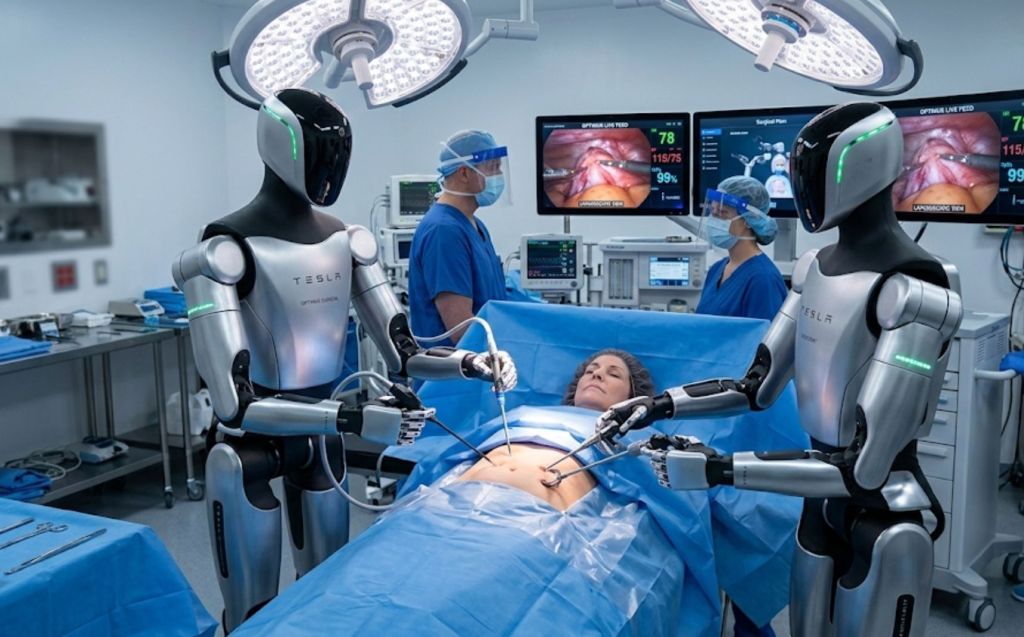
Zonkatron’s Prediction
Robot manufacturers are currently unwilling to accept legal responsibility for surgical errors, meaning a human “patsy” (the surgeon) must still be in the loop.
While a robot might excel at a “perfect” procedure, they lack the creative problem-solving needed when surgery goes wrong (e.g., unexpected bleeding or anatomical variations). Therefore, robots are not replacing surgeons anytime soon especially in poor countries.
Robots will start practically replacing surgeons only after about 70 years, so in the next century!
Why the Future of Surgery Still Belongs to Humans?
If you have read any tech headlines recently, you might think human surgeons are on the verge of extinction. We hear constant praise for autonomous surgical systems, high-precision robotic arms, and AI-driven diagnostics. The popular narrative suggests that it is only a matter of time before a machine takes over the operating room entirely, delivering flawless, sub-millimeter cuts without a trembling hand or a moment of fatigue.
It is a compelling vision, but it misses a critical reality of medicine: the body is not a blueprint, and an operation is rarely a scripted event.
While automated systems and robotic assistants excel when a procedure goes strictly according to plan, they fail when things go wrong. Because human anatomy is chaotic and unpredictable, human surgeons are not being replaced by robots anytime soon—especially in low-income and developing nations.
The Illusion of the “Perfect” Procedure
On paper, robots sound unbeatable. Modern surgical systems can execute precise incisions, eliminate physiological hand tremors, and access tight anatomical spaces with steady, multi-jointed tools. When operating on a textbook subject—where the anatomy matches the scans perfectly and no surprises occur—a machine can perform with mechanical perfection.
However, “textbook” patients are rare.
Human anatomy is notoriously variable. Organs can be displaced, scar tissue from past illnesses can bind structures together in unexpected ways, and blood vessels do not always follow the map. A robot trained on standardized data struggles when it encounters an anomaly that breaks its programmed parameters.
Consider what happens when a surgery derailed:
Unexpected Hemorrhage: A sudden rupture of a major artery floods the surgical site. The immediate visual field is lost, and blood obscures the camera sensors. A robot relies on clear, structured visual feedback. A human surgeon, however, relies on years of tactile experience—feeling for the pulse, manually applying pressure to the right area, and adapting instantaneously to control the bleed.
Severe Adhesions: Dense scar tissue from a prior infection might fuse the bowel to the abdominal wall. A machine attempting a standardized cut can easily perforate an organ. A human surgeon uses spatial intuition, delicate tactile feedback, and creative workarounds to slowly peel tissue apart without causing catastrophic damage.
When surgical emergencies strike, rigid rules and algorithmic logic fall short. What saves a patient’s life in those critical seconds is creative problem-solving: the human ability to improvise under extreme stress, synthesize incomplete information, and pivot strategies instantly. A robot does not possess intuition, instinct, or real-time adaptability.
The Reality in Developing Nations
Even if we eventually develop an artificial intelligence capable of true surgical improvisation, another massive barrier remains: economic and structural reality.
Robotic surgical platforms carry staggering costs. A single advanced unit typically costs between $1.5 million and $2.5 million USD up front, with hundreds of thousands of dollars in annual maintenance contracts and thousands of dollars in disposable parts for every single operation.
For the price of one surgical robot, a health system in a low-income region can fund entire primary care networks, purchase dozens of basic ultrasound machines, or train scores of local medical professionals. Investing in multi-million-dollar robots in areas lacking basic health infrastructure is both financially impractical and ethically questionable.
The Path Forward: Assistants, Not Replacements
Robots will continue to transform the operating room, but not as independent replacements for human experts. Instead, they will remain what they have always been: powerful extensions of the surgeon’s hands.
The future of global surgery does not belong to autonomous machines operating in a vacuum. It belongs to skilled human surgeons who bring adaptability, compassion, and creative problem-solving to the table—supported by technology where it is affordable, but never reliant on it when human life is on the line.


Leave a Reply