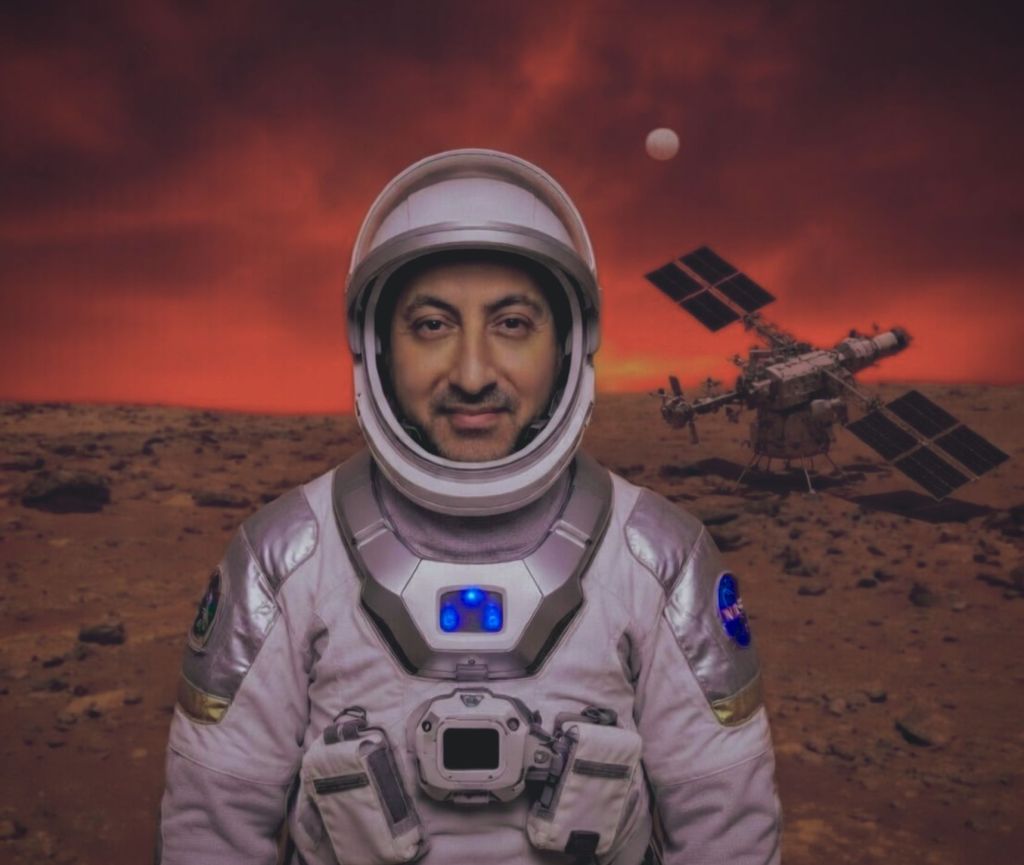
While the word “impossible” is a strong term in science, space agencies like NASA and SpaceX currently face five huge challenges that make it impossible to land a human on Mars until at least 150 years.
These aren’t just difficult; they are hurdles where a single failure means certain death for the crew.
1. The “Death Zone” of Landing (EDL)
Landing on Mars is significantly harder than landing on the Moon or Earth. This is known as the Entry, Descent, and Landing (EDL) problem.
The Atmosphere Trap:
Mars’ atmosphere is “too thick to ignore, but too thin to use.” It’s thick enough to create lethal heat during entry, but 100 times thinner than Earth’s, meaning parachutes are almost useless for heavy human-scale landers.
The Weight Limit:
We can currently land about 1 metric ton (the size of a rover). A human mission requires landing 20+ metric tons. Scaling up current technology to that weight without the ship simply “pancaking” into the surface is a feat we haven’t yet mastered.
2. Galactic Cosmic Rays (GCRs)
On Earth, our magnetic field and atmosphere act as a shield. In deep space, astronauts are “naked” to two types of radiation.
Solar Flares:
These are bursts of protons that can be shielded with thick walls or water tanks.
Galactic Cosmic Rays:
These are high-energy particles from outside our solar system that move at nearly the speed of light. They are so powerful they can pass through lead and aluminum, shattering DNA and causing “secondary radiation” (shrapnel) when they hit the ship’s hull. A round-trip mission currently exceeds the lifetime radiation limits allowed for any astronaut.
3. The Physiological “Wasting” Problem
Prediction: If we put a healthy human being on Mars today, he will be able to live for only a few months or maybe less before his body shuts down.
Humans evolved for 1g (Earth gravity). During the 6–9 month journey in 0g and the stay on Mars (0.38g), the body undergoes drastic changes.
Bone and Muscle:
Astronauts lose about 1–1.5% of bone mineral density per month. By the time they land on Mars, their bones could be as brittle as a 90-year-old’s, making a simple stumble a leg-breaking event.
Fluid Shifts (SANS):
Fluids move toward the head, increasing pressure on the brain and permanently flattening the eyeballs, which can lead to blindness before the mission even ends.
4. The Logistics of “Life Support”
On the International Space Station (ISS), if a water recycler breaks, a resupply ship can arrive in weeks. On Mars, help is at least two years away.
Closed-Loop Failure:
Current tech isn’t 100% efficient. We need to recycle nearly every drop of sweat and urine and every breath of CO2 back into oxygen. If the system fails by even 5%, the crew runs out of air or water long before they can return.
Dust Toxicity:
Martian dust is not just “dirt”; it contains perchlorates (toxic salts) that are corrosive to electronics and lethal to human lungs if even a small amount is tracked into the habitat.
5. Psychological “Earth-Out-Of-View”
This is the only challenge that cannot be solved with engineering.
Total Isolation:
On the Moon, Earth is a big, beautiful marble in the sky. On Mars, Earth is just a tiny, faint blue dot.
Communication Lag:
There is a 20-minute delay each way for signals. You cannot have a conversation; you can only send “video mail.” In a life-or-death emergency, the crew is entirely on their own. The psychological strain of being the first humans to truly “leave” Earth’s vicinity is a variable flight surgeons are deeply worried about.

 Zonkatron
Leave a comment